

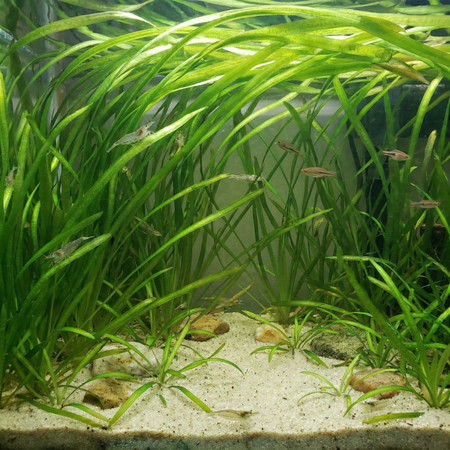
3 Vallisneria Aquascaping Layouts: Curtain Background, River Channel, and Meadow
Posted by Artur M. Wlazlo on 29 Jan 2026
Vallisneria is one of those rare aquarium plants that can look intentionally designed or completely natural—sometimes in the very same tank. The reason is simple: val is both architectural and organic. Its long leaves create strong lines that shape the viewer’s eye, yet the plant grows like real shoreline vegetation—rooted, persistent, and always trying to spread into a meadow. That combination makes Vallisneria a perfect “layout plant,” not just a background filler.
In this guide, we’re focusing on aquascaping—specifically three Vallisneria planting approaches that consistently produce beautiful results. Each option works in both beginner and advanced setups, and each can be built with Vallisneria varieties commonly available at Modern Aquarium, including classic straight-leaf types and the more textured corkscrew/contortion styles. The best part is that you don’t need an elaborate plant list. With vallis done right, your aquarium can look mature, natural, and cohesive without feeling crowded.
Option 1: The Clean Curtain Background
The simplest way to make a tank look finished—fast.
If your aquarium feels visually “busy” (equipment showing, hardscape not blending, fish looking exposed), the clean curtain solves it in one move. You plant Vallisneria in a deliberate line along the back glass and let it grow into a soft green wall. Once established, the leaves sway in the flow and create a living backdrop that makes everything in front of it pop—rocks look bolder, driftwood looks more natural, and fish look more confident.
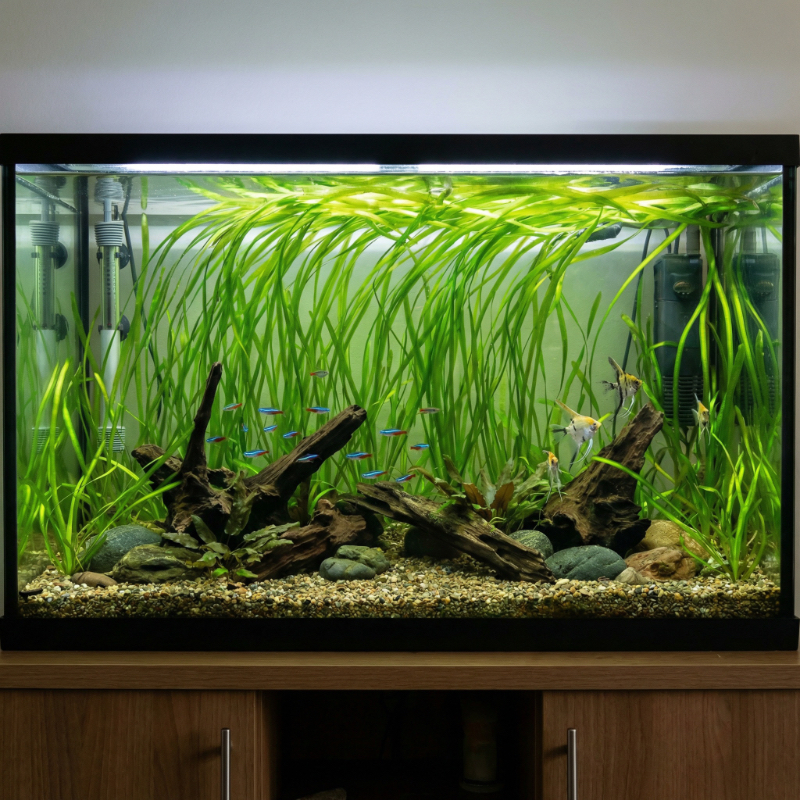
This option is also the most forgiving to maintain. You’re not trying to sculpt a complicated shape; you’re letting vallis do what it wants to do, just in a defined zone.
The “secret” here is planting depth and spacing. Vallis needs the crown exposed and the roots anchored, and it needs room to spread so it fills in cleanly instead of becoming a tangled clump.
-
Plant vallis in a row along the back, leaving a little space between plants so runners can travel.
-
Bury the roots only and keep the crown (where leaves emerge) at or slightly above the substrate line.
-
If you’re mixing types, put taller growth toward the corners and slightly shorter growth toward the center for a natural frame.
As the background thickens, you can decide what “finished” means for your taste. Some aquarists prefer a dense wall that hides everything. Others like a curtain with subtle openings that show depth behind hardscape. Either way, the clean curtain is the easiest layout to get right, and it’s a favorite for community tanks because it creates calm.
Option 2: The Side-Framed River Channel
A layout trick that makes tanks look larger and more “scaped.”
This is the option for aquarists who want the aquarium to feel like a place you could step into. Instead of planting the back wall evenly, you plant Vallisneria as “riverbank growth” on the left and right sides, leaving an open lane through the middle. Your eye follows that open channel naturally, and the tank gains perspective—often making it look bigger than it actually is.
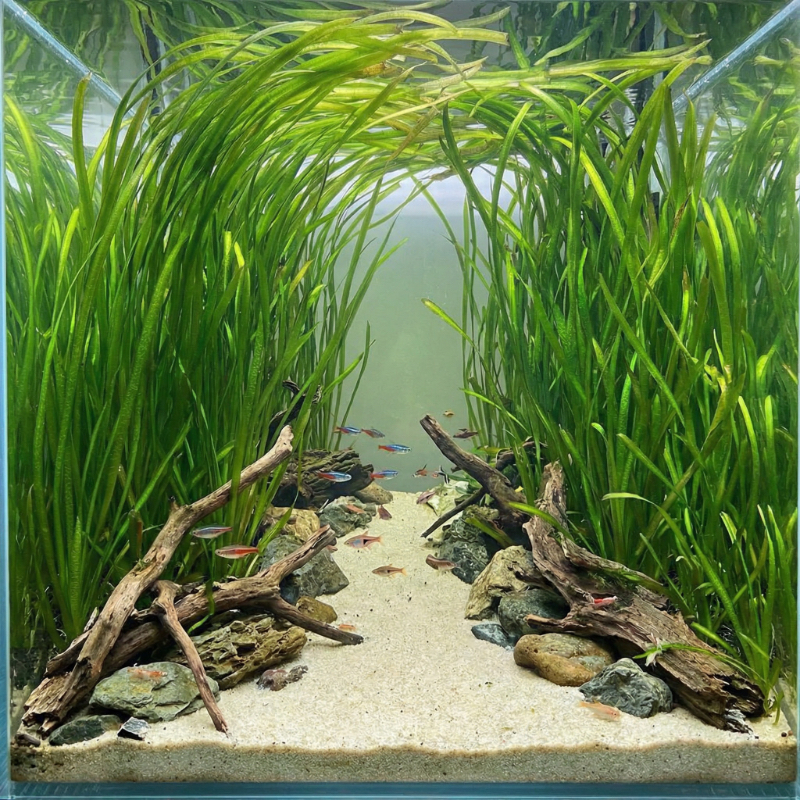
This approach also makes fish behavior look great. Schooling fish use the open lane like a runway, while shy fish hang back at the edges where Vallisneria creates shelter. Shrimp and bottom dwellers benefit too, because the banks give them structure without blocking the whole foreground.
Think like a shoreline. Dense growth at the edges, open water in the center.
-
Plant vallis in two sweeping clusters—rear-left and rear-right—rather than a straight line across the back.
-
Leave a clear channel in the middle; an angled channel often looks even more natural than a perfectly centered one.
-
Use your filter outlet so leaves gently lean toward the channel, which “guides” the viewer’s eye and adds motion.
This layout pairs beautifully with hardscape. Rocks and driftwood can sit near the banks, while the open channel stays visually clean. If you want extra texture without adding more species, a corkscrew/contortion Vallisneria variety is an easy upgrade: it keeps the same “vals-only” simplicity, but adds movement and character to the edges.
Option 3: The Vallis Meadow
The most natural look—because it’s how vallis grows in the wild.
A Vallisneria meadow is less about arranging and more about collaborating. You plant a starting pattern, then let runners do the long-term work. Over time, val turns open substrate into a living field. It’s one of the most habitat-like looks you can create in a freshwater tank, and it’s especially loved in shrimp setups and peaceful community aquariums because it creates countless micro-shelters without feeling heavy or overgrown.

What makes a meadow look “intentional” instead of messy is boundary control. You decide where the meadow lives, where it stops, and where you want open negative space to remain.
The biggest mistake with meadows is planting too densely at the start. Vals fill gaps on their own—your job is to give them a map, not a finished picture.
-
Plant small groups with visible gaps between them so runners have somewhere to go.
-
As daughter plants appear, replant them into empty spaces to “steer” the meadow and thicken it evenly.
-
Control edges early by removing runners that cross into areas you want to keep open (a path, a sandy foreground, a rock garden).
A Vals meadow also evolves in a satisfying way: the tank changes week by week, looking more established as the plant network expands. If you enjoy watching an aquascape mature naturally rather than staying frozen in time, this option is hard to beat.
How Many Vallisneria Plants Should You Start With?
Vallisneria spreads. The goal is not to plant a “final” layout on day one; it’s to plant a smart beginning and let runners fill in. Start modestly, then expand by propagation. You’ll get a cleaner result and better control.
-
10–20 gallons: start with 3–6 plants
-
29–40 gallons: start with 8–10 plants
-
55+ gallons: start with 12–16 plants
Once runners begin, you can decide whether to let vals take over, relocate daughter plants into bare areas, or keep it tightly contained to preserve open space.
Vallisneria is a Layout Plant, Not Just a Plant
A lot of aquarium plants are chosen for color, difficulty, or growth rate. Vallisneria is chosen for something more fundamental: it shapes the aquarium. It can be a clean green backdrop that hides equipment and calms the whole scene. It can create a river-channel illusion that makes the tank feel larger and more professional. Or it can grow into a true underwater meadow that looks like it belongs to fish and shrimp—not just to the aquarist.
If you’re building a planted tank and want a layout that gets better with time, Vallisneria is one of the best places to start—especially when you choose a variety that fits your style and then let it do what it does best: root, rise, and spread.