

Posted by Artur M. Wlazlo on 29 Jan 2026
Vallisneria in the Planted Aquarium: Turning Glass Boxes into a Living Riverbank
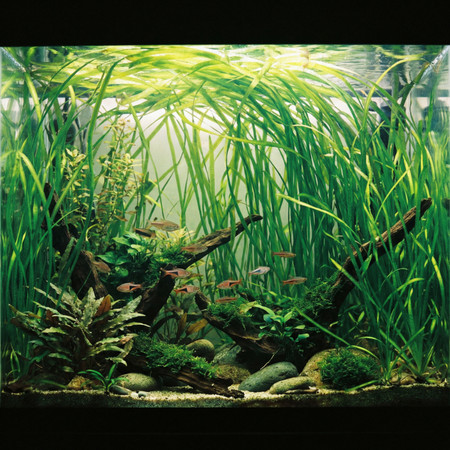
There are certain plants that don’t just “decorate” an aquarium—they change the entire feeling of it. Vallisneria is one of those plants. The first time you see a healthy stand of vals in motion, it clicks: the tank stops looking like a container and starts looking like a place. Long, ribbon-like leaves rise from the substrate, bend with the current, and form a soft green curtain that makes fish feel secure and makes aquascapes feel bigger than they are. That’s why Vallisneria has been a staple in freshwater tanks for decades, and why it’s still one of the smartest choices you can make when you want a natural-looking, low-drama planted aquarium that grows in beautifully over time.
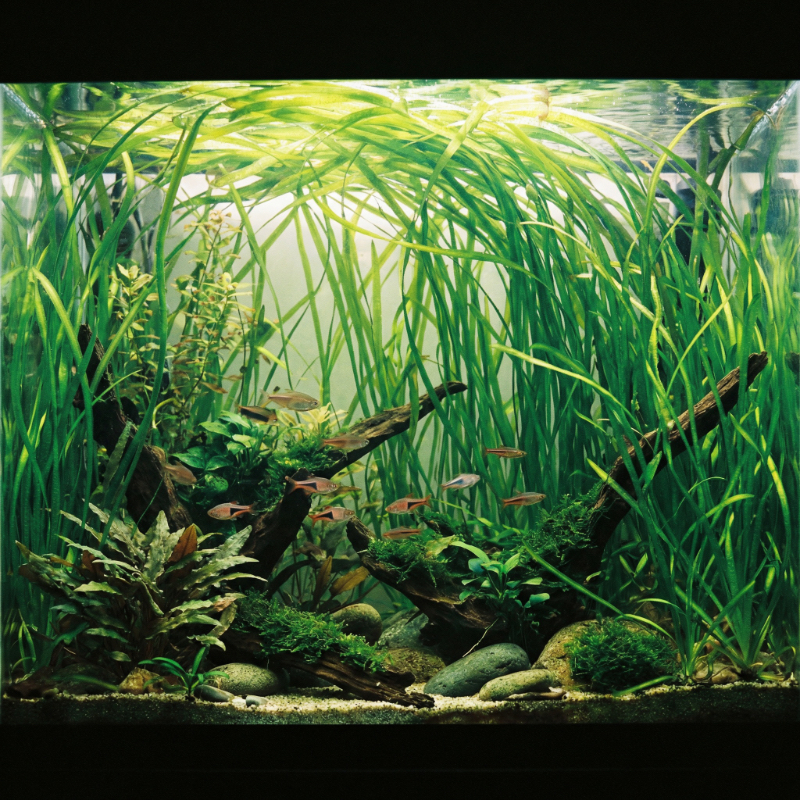
Vallisneria (often shortened to “vallis”) is a true freshwater, rooted rosette plant that spreads by runners. In the wild, different Vallisneria species show up across a wide range of regions and habitats—lakes, slow rivers, shallows—places where light reaches the bottom and plants can form underwater meadows. That natural history explains almost everything you experience with it in the aquarium: it wants to anchor, reach upward, and then multiply outward. When it’s happy, it doesn’t merely survive; it starts quietly building structure in your tank—one runner at a time—until you have the kind of lush background that looks intentional even if you didn’t overthink it.
And that’s the real Vallisneria magic: it’s both simple and powerful. You can plant a few and let them do their thing, or you can use them with real purpose—framing hardscape, hiding equipment, defining “zones” for fish, and guiding the viewer’s eye through the layout. Either way, Vallisneria rewards patience.
The look: from clean ribbons to corkscrew texture
Most people imagine Vallisneria as long green tape—classic ribbon leaves that read like submerged grass. That classic form is timeless because it’s calm. It creates lines that are easy on the eyes and it blends into almost any aquascape style: jungle, nature, riverbank, minimalist, community tank, shrimp tank, you name it.
But Vallisneria isn’t one look. Some varieties twist and spiral, adding texture and movement even when the tank is still. Others grow taller and bolder and are best suited for bigger aquariums where they can arc and sway without swallowing the whole scene. At Modern Aquarium, exploring different vals options is one of the easiest ways to change the “personality” of a planted tank without changing your entire plan—because the plant does so much visual work all by itself.
If you’re deciding whether vallis is “worth the space,” think beyond aesthetics. The biggest benefit is often what you notice in your livestock—more natural behavior, more confidence, and less stress.
-
Security and structure for fish: Vallis beds break up open sightlines, which can reduce chasing and help timid fish stay out and about instead of hiding all day.
-
A grazing zone for shrimp: Leaves collect biofilm and fine particles; shrimp spend all day picking and cleaning, and Vallisneria gives them more surface area to do it.
-
A better sense of territory: In community tanks, visual boundaries matter. Vallis can create gentle “rooms” in the aquarium without hard walls.
That’s why Vallisneria so often “improves the tank” even when you can’t quite put your finger on why.
Care that actually feels easy (when you get the fundamentals right)
Vallisneria has a reputation for being forgiving—and it usually is—but the key is understanding what it’s trying to do. Vallisneria is a rooted plant that wants to feed from the substrate, stabilize, and then spread. If you give it a decent base and consistent conditions, it tends to settle in and take off.
Light is the first lever. Moderate light is enough for many Vallisneria varieties to grow steadily, while stronger light generally speeds things up (sometimes a lot). CO₂ is optional. Vals can do well in low-tech tanks without injected CO₂, but in higher-energy planted tanks it may grow faster and fill in sooner. Temperature is rarely the issue in typical tropical community ranges. The more common swing factor is nutrient availability—especially at the roots.
If your substrate is nutrient-rich, Vallisneria often establishes quickly. If your substrate is inert (like plain gravel), Vallis can still thrive, but it’s more likely to appreciate root-zone support and a consistent fertilization routine. In other words: vallis doesn’t need you to overcomplicate things—it needs you to be steady.
Planting Vallisneria the right way (and avoiding the “melt panic”)
A lot of people’s first Vallisneria experience goes like this: they plant it, it looks fine, and then it starts melting. Leaves thin, yellow, go translucent, or die back. This can be completely normal during transition—especially when a plant is moved between very different growing conditions. What matters is not the old leaves; what matters is whether the plant starts producing new growth that matches your aquarium.
Here’s the planting approach that tends to give Vallisneria the smoothest start. Vallisneria’s crown (the base where leaves emerge) is the make-or-break detail. Plant too deep and it struggles. Plant too shallow and it floats.
-
Bury the roots, not the crown: Tuck roots in and keep the crown at or just above the substrate line.
-
Give it room: Vallis spreads by runners. Space now prevents chaos later.
-
Plant, then pause: Avoid constant replanting and rearranging in the first couple of weeks—stability helps it settle.
If some older leaves melt, don’t treat it like a failure. Treat it like a transition. Once you see clean new leaves forming and the plant stays anchored, you’re on the right track.
Designing with Vallisneria: how to make it look intentional
Vallisneria is one of the best plants for creating depth and scale, and the reason is simple: it forms a background that isn’t flat. As leaves rise and arc, they create layers—especially when water flow makes them move. That movement gives your aquascape life.
The easiest “win” is to use Vallisneria as a background curtain to hide heaters, intakes, and other equipment. But you can go further. Vals are also excellent along the sides of the tank, framing an open center like a river channel. It can sit behind driftwood and rock to soften hard edges and make hardscape feel embedded rather than placed. In nature-style layouts, Vallisneria often acts like the “sky” behind the scene—it’s the quiet backdrop that makes everything else pop.
At Modern Aquarium, many aquascapers pair Vallisneria with hardscape that adds contrast—textured rocks or natural driftwood—because ribbon leaves and rugged surfaces complement each other instantly. You don’t need a complicated plant list when your background already looks like nature.
Trimming and long-term maintenance: keep the meadow, lose the mess
Once Vallisneria takes hold, your job shifts from “will it grow?” to “how do I keep it looking clean?” The answer is mostly runner management and selective removal.
If you want a dense Vallisneria meadow, let runners establish and fill in. If you prefer a more curated look, remove new runners early or relocate daughter plants to the places you actually want them. This is one of the most satisfying parts of Vals: it’s a plant that helps you expand your aquascape without re-buying your background every time.
When trimming, many aquarists find it cleaner to remove older outer leaves near the base rather than chopping leaf tips. Tip-cutting can leave blunt ends that age poorly. A little selective leaf removal keeps the stand looking natural and keeps water flow moving through it.
Common problems (and what they’re usually telling you)
Most Vallisneria “issues” are messages, not mysteries. Yellowing often points to nutrition (especially in root-feeding), slow growth with algae pressure often points to a mismatch between light and available nutrients, and rampant runners usually mean: congratulations, it’s happy—now decide what shape you want your aquascape to become.
The key is to resist the urge to react daily. Vallisneria responds best to consistency. When you keep light duration reasonable, keep nutrients steady, and avoid uprooting it repeatedly, it tends to stabilize and then begin the slow, confident expansion that makes it such a staple plant.
Vallisneria is the kind of plant that quietly upgrades your aquarium in every direction at once. It gives fish cover without clutter, gives shrimp structure without fuss, and gives aquascapes depth without demanding expert-level skills. Most importantly, it grows with you: you can start with a few plants, learn how your tank behaves, and let Vallisneria build the background over time—until your aquarium looks like it’s always been that way.
Once you understand what Vallisneria wants—stable conditions, a healthy root zone, and time to settle—it stops feeling like “just another background plant” and starts becoming a true design tool. The real fun begins when you use vallis intentionally to shape the aquarium: hiding equipment with a clean green curtain, framing a river-like open channel, or letting it spread into a natural meadow that fish and shrimp treat like home. If you’d like step-by-step planting approaches you can copy, check out our companion guide on three Vallisneria aquascaping layouts—each one designed to help you build a tank that looks cohesive from day one and gets better with every new runner.